

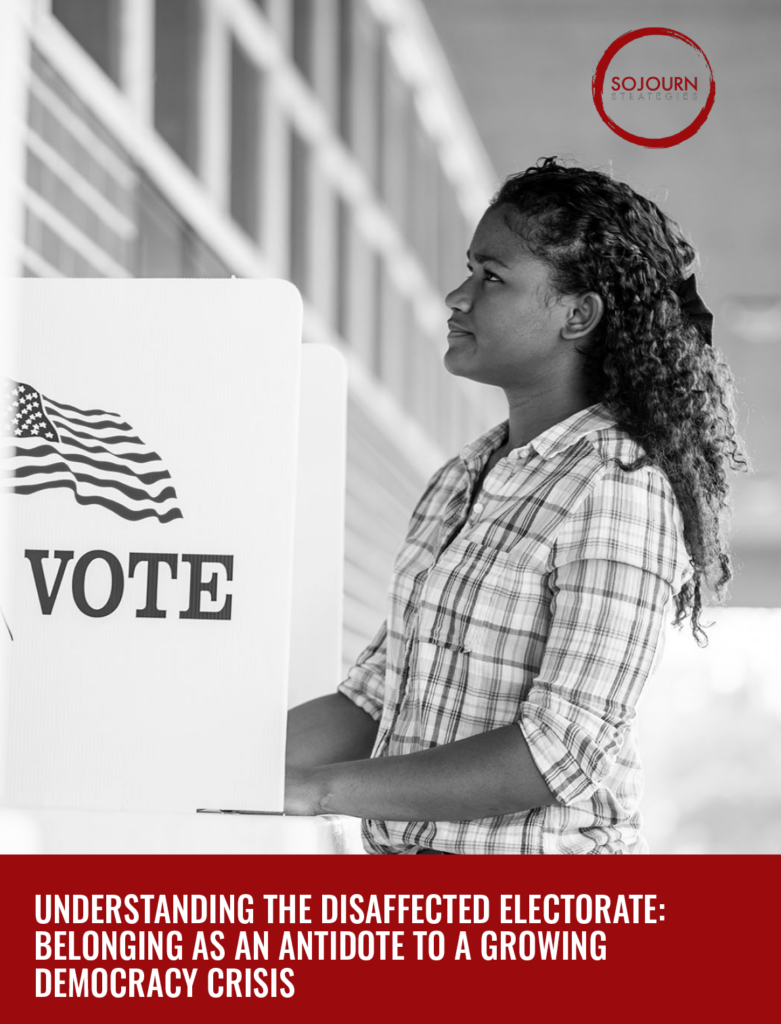
UNDERSTANDING THE DISAFFECTED ELECTORATE: BELONGING AS AN ANTIDOTE TO A GROWING DEMOCRACY CRISIS
The United States is facing a critical crisis of democratic disconnection, marked by historic lows in government trust, declining youth voter turnout, and widespread social isolation. This converging disruption has left millions of Americans losing faith in their own agency and the capacity of political institutions to deliver for their families. Because this deep-seated cynicism cannot be repaired by standard electoral strategies, there is an urgent need for trust-building and organizing rooted in collective community action.
Recognizing this trend, the Democracy & Power Innovation (DPI) identified a pivotal segment across Black, Latino, and AAPI communities known as the “Rightfully Cynical”—individuals whose alienation stems from lived experiences of institutional failure. To bridge this divide, grassroots organizations must bring these frustrated individuals into organized power. The goal goes beyond merely influencing the next election; it aims to build the enduring collective influence necessary to transform the nation into a true multiracial democracy.
To review the full report, complete the form by clicking the “Download” button.
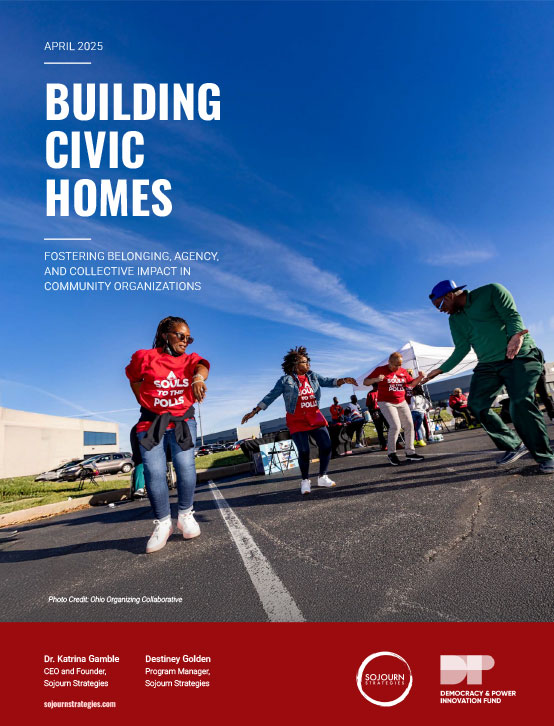
DISCOVER WHAT IT TAKES TO BUILD A CIVIC HOME
The United States is in the midst of an era of growing political polarization, isolation, and what some have even described as a loneliness epidemic. The result is large segments of voters feeling disillusioned with democratic institutions. Our research suggests that civic homes can potentially serve as an antidote to the growing levels of disengagement and disconnection in the United States.
Our report, Building Civic Homes, conducted in partnership with the Democracy & Power Innovation Fund identifies what makes effective civic homes. We explored what brings people into organizations and what makes them stay. We found that belonging — spaces where people feel seen, heard, and safe — is foundational to building an effective civic home.
To review the full report, complete the form by clicking the “Download” button.
BUILDING BLACK POLITICAL POWER AT THE INTERSECTION OF MOVEMENT AND ELECTORAL JUSTICE
The contemporary Black liberation movement often referred to as the Movement for Black Lives (M4BL) or Black Lives Matter movement (BLM) first arose in early 2013 in reaction to the murder of Trayvon Martin and took on increasing momentum during the Ferguson uprising in 2014 after the killing of Michael Brown. While the movement galvanized around these pivotal organizing moments regarding state-sanctioned violence and brutality — it has become a broad movement grounded in a vision for Black liberation.
In this groundbreaking report Sojourn Strategies in partnership with ThinkRubix and the Electoral Justice Project explores the impact of Black social movement engagement on voting and other forms of civic participation among young Black people
To review the full report, complete the form by clicking the “Download” button.
THE POWER OF BUILDING A POLITICAL HOME: BLACK CIVIC ENGAGEMENT AND MOVEMENT ORGANIZING
Black people’s views, as always, are complicated and multifaceted, and knowing how to make sense of the nuance and intersectionality within the Black community is as important as ever. 2020 was a year of disruptions that had a disproportionate impact on Black people – from the economic impact of the COVID-19 pandemic to the continued and increased police violence targeting Black people. Yet, in a year of disruptions Black people still turned out to vote in record numbers and in ways that were decisive to the electoral outcomes in many states. This report begins to unpack this dichotomy of Black political disillusionment and continued civic participation.
To review the full report, complete the form by clicking the “Download” button.