

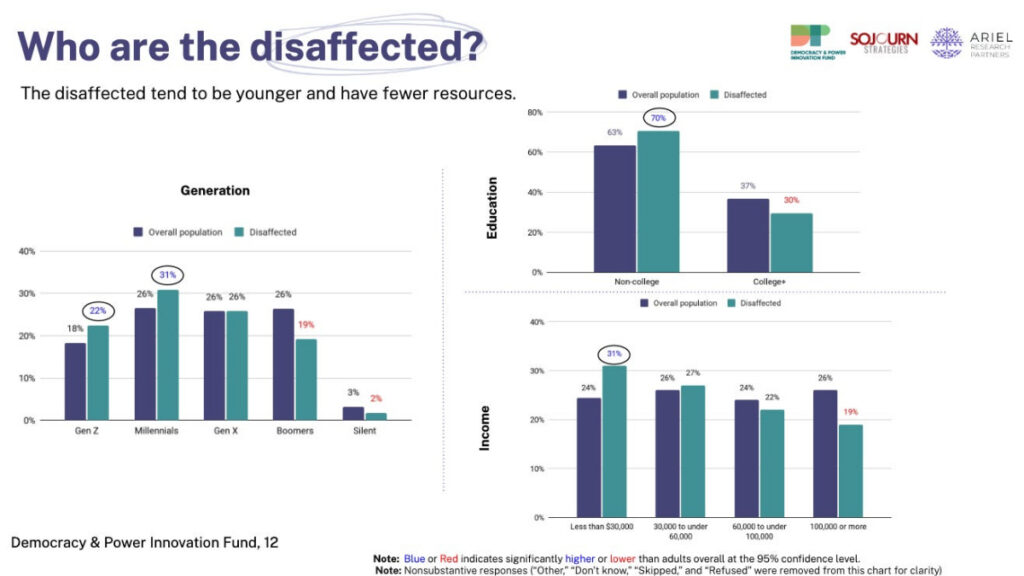
A new, comprehensive multiracial survey of the disaffected electorate, done by Dr. Katrina Gamble for the Democracy & Power Innovation Fund, found that members of this demographic are just as likely as the overall population to talk about politics with a friend or family member, search online for political information, contact an elected official, go to a protest or volunteer for a political or civic group. If anything, they are more likely (by a modest degree) to do things such as sign a petition, boycott a product, make political art or music, or help neighbors with childcare or other forms of support. Like the rest of the population, about six in ten of the disaffected electorate say they would like to “feel more connected to people in my community.”
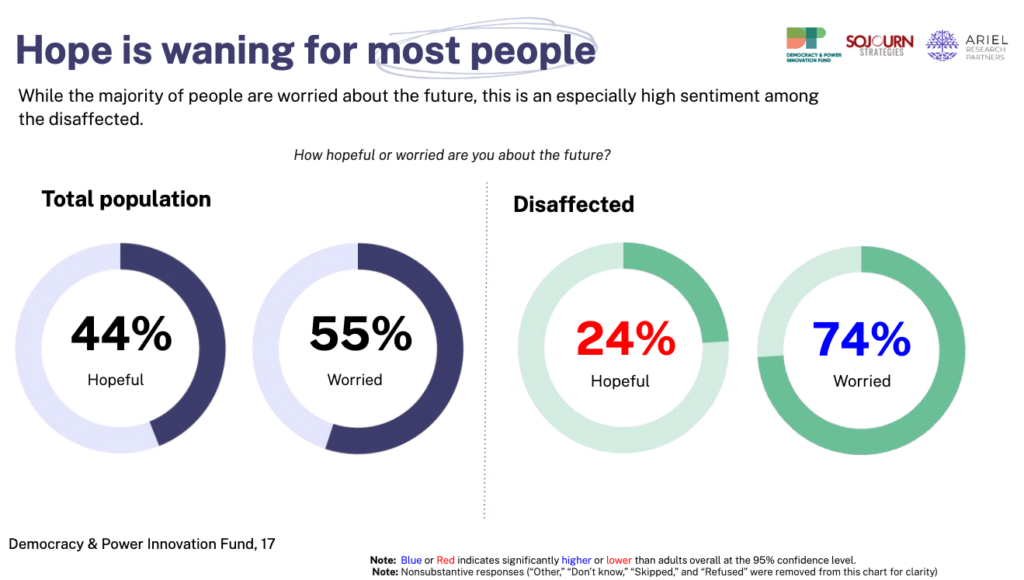
But what makes them different from the rest of the population is a much higher feeling of disillusionment and distrust in institutions. They are younger and have fewer resources, which undoubtedly explains their greater disaffection; the cost of living is a significantly greater concern for this group. They also have lower feelings of agency and higher feelings of powerlessness. And they expressed a significantly lower intention to vote in November, just 56% saying so compared to 65% for the overall population.
Last week, I talked with Dr. Gamble about this new study, which involved a total sample of 4.506 respondents, including 1,147 who were Black, 1,154 who were Hispanic, 1,691 who were white and 1,092 who were Asian/Pacific Islander. She made several additional points.
- “A lot of folks have assumed that this frustration and disillusionment means that people are totally checked out and not participating. And I honestly went into this thinking we would find something similar, but one of the most interesting findings we found is that this the impact on participation is very specifically impacting voting. That folks who have this sense of disaffection aren’t necessarily unengaged in civic life; they’re just choosing to do other things outside of voting, which is interesting–they’ve made some calculation that they’re only going to spend their time doing what matters, and they’ve decided that voting is not one of those things.”
- “The frustration that people are feeling is very specifically about the federal government. Sure, not that the trust at the state and local level is through the roof, but the things that they were describing that were making them feel let down and disillusioned about politics were very specifically about this administration and some of the things that the federal government is doing.”
- “After a regression analysis, where we controlled for a whole host of other factors, we found that belonging was the biggest predictor of whether the people who are disaffected would take some form of civic participation. It you go from the lowest level on that belonging scale to the highest, your likelihood to vote in 2026 goes up by 25%. That’s a hard thing to do, right? To move someone from zero to one on that scale, but if you translate that even into an incremental change, so you went from zero to 0.1 of some sense of increased belonging, the data suggests that that in itself would also increase your likelihood to vote in 2026 two-and-a-half percent relative to someone who’s on the lower end.”
I’m a big fan of DPI’s work and the kind of civic homes that it is investing in building. But I wanted to know if there was anything in the research that said that the kind of belonging or home that would work to address this combination of frustration and distrust trends in the direction of small-d democratic. After all, Turning Point Action or a local gun club or an evangelical church are also places that offer people a strong sense of belonging. Gamble agreed that the right and the left can both create civic homes for people. But she added that the disaffected voters she was focused on also clearly want places that accept them as they are.
“When we talk to folks in the focus groups, we did ask what the qualities that a place, like an organization or a space, would need to have in order for you to join? And folks talked about it being a place where they feel trusted, where they feel safe, where they feel comfortable. So, basically, people want to feel accepted. They want to feel included. They also talked about the fact that they wanted to be a place where they’re getting something out of it, and that’s not necessarily transactional. They talked about making more connections with friends and things like that. They would go with someone that they trusted, who invited them into that space. And so, none of those qualities is about a particular ideology. It’s really just about how people feel and how they are relating to the other people in that space. And so, to your point–there have been people creating civic homes for people to move them in ways that are antithetical to our democracy. But it also means that there is an opportunity for folks who are champions of democracy to create those same spaces and bring people into those spaces.”
One model of this work that Gamble pointed me to is an organization called Power Interfaith in Pennsylvania, a faith-based organizing group that is part of the DPI network. For the last few years, it has been experimenting with hosting “soul food dinners” for small groups in community spaces where people share a meal and have an open-ended conversation about how they’re feeling about what’s going on in their community. “There’s not an immediate ask to do something or vote for someone or turn out for an election,” Gamble noted. Power Interfaith is finding that some people want to continue meeting, and “over the course of that, they’re starting to see that people who come back into those spaces in a in a consistent way have a higher sense of agency.” She added, “It’s still early and they’re still pulling the data. But that’s an example where organizations are just trying to find spaces of community first, build that sense of belonging, like the sentiments that people want, and then kind of move towards the work of building agency and then moving people to take action. It’s just it’s a slower process.”
Gamble argues that the implications of this research and experimentation is clear. “It’s the most significant way to actually move that segment of the electorate in a way that’s sustainable. In some of the focus groups, people talked about this idea that most of their interactions around elections is really transactional. They talked about how people come and they make all these promises and then they don’t deliver and they don’t ever hear from them again.” She added, “I do think that in some ways, the way that the political industry has treated people–there’s almost this assumption that they don’t understand that they’re being used–but people are very clear that they’re being used, and that’s part of what’s driving the frustration. There was like one young woman in a focus group who said ‘I used to really care about elections and I turned out to vote and nothing really happened and I never heard from these people again. So now I don’t bother with it. I just do what I can to take care of my family.’ And so in some ways, we’re actually doing harm by treating, especially this group of people who already have a sense of distrust, in a super transactional way, because it’s only feeding into what they already believe is a system that is not really meant for them and is not engaging them in a real way, but just using them for their vote.”
Source: The Connector